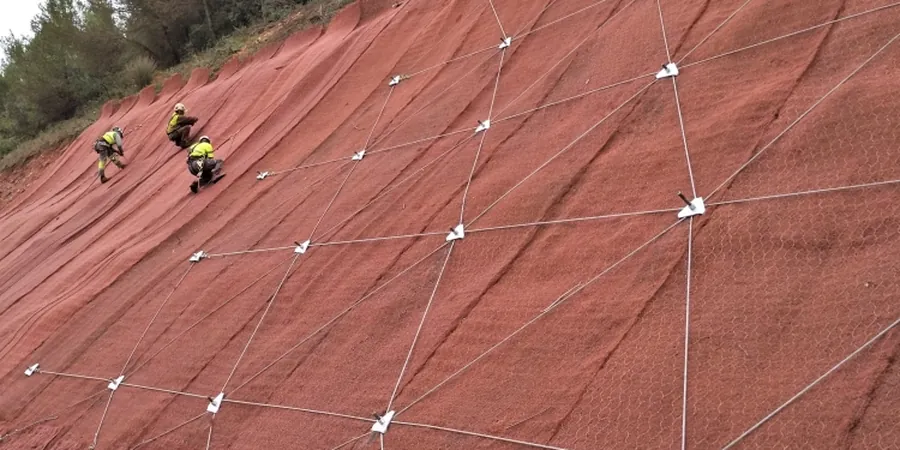
The soil conditions in Streeterville versus those along the Palos Hills moraines tell two completely different stories for any engineer dealing with excavations or waterfront structures. Downtown Chicago rests on a sequence of glacial till, lacustrine clays, and urban fill that can misbehave when cut angles get aggressive, while the bluffs near the North Shore present erosion-driven stability problems tied directly to Lake Michigan water levels. What ties both scenarios together is the need for a slope stability analysis that goes beyond textbook assumptions. We have worked across enough Cook County sites to know that the Chicago Building Code’s reference to IBC Chapter 18 is just the starting point. A reliable slope stability analysis here must incorporate site-specific shear strength from consolidated-undrained triaxial tests and a stratigraphic model that captures the compressible Chicago clay layers, because ignoring those soft seams can turn a routine excavation into a costly delay.
In Chicago's glacially compressed clays, a slope stability analysis without pore pressure monitoring can overestimate the factor of safety by 30 percent or more.
Local context
A 6-story residential project we consulted on near the North Branch Canal ran into trouble when the contractor assumed a 1H:1V cut in saturated sandy fill would hold through November rains. The fill, sitting on a weathered shale layer, mobilized a translational slide that pushed the adjacent alley pavement up by four inches over a weekend. The original geotechnical report had not run a slope stability analysis for the temporary excavation condition, only for the permanent retaining wall. We stepped in and modeled the transient pore pressure response using a finite element seepage analysis, then back-calculated the operational friction angle, which ended up closer to 28 degrees than the 34 originally assumed. The solution involved a modest bench at mid-height and a dewatering well array that dropped the phreatic line enough to regain the required factor of safety. In Chicago, where winter freeze-thaw cycles loosen the upper five feet every spring, a stability check for construction-phase conditions is not optional; it is the difference between a controlled dig and an emergency shoring call.
Top questions
What soil units in Chicago create the most slope stability problems?
The compressible Chicago clay (Wadsworth Formation) and the saturated urban fill near the lakefront cause the majority of instability issues we see. The clay loses significant strength when remolded, and the fill often contains pockets of sand and debris that channel groundwater unpredictably. Any slope stability analysis here must separate these units carefully, because lumping them into one material parameter set will mask the failure mechanism.
How much does a slope stability analysis cost for a typical Chicago excavation?
For projects within the Chicago metro area, a slope stability analysis that includes limit equilibrium modeling, multiple piezometric scenarios, and a technical report with recommendations typically ranges from US$1,370 to US$4,780. The final cost depends on the number of cross sections, whether we need to run laboratory shear strength tests on site-specific samples, and if transient seepage modeling is required for the construction staging.
Do Chicago building officials require a slope stability analysis for temporary excavations?
Yes, the Chicago Department of Buildings enforces IBC Chapter 18, which requires a stability evaluation for any excavation deeper than 20 feet or adjacent to existing structures. We have submitted multiple reports to the city for projects along the Chicago River and near the CTA tunnels where the temporary cut stability was the controlling design case, not the permanent wall condition.
How does Lake Michigan water level fluctuation affect slope stability near the shore?
Rapid drawdown is the critical condition. When lake levels drop after a period of high water, the stabilizing hydrostatic pressure on the slope face disappears faster than the internal pore pressures can dissipate, creating an undrained unloading scenario. We model this explicitly using transient seepage coupled with the limit equilibrium analysis, and we typically find the factor of safety drops 15 to 25 percent during a 3-foot drawdown event in sandy shoreline bluffs.