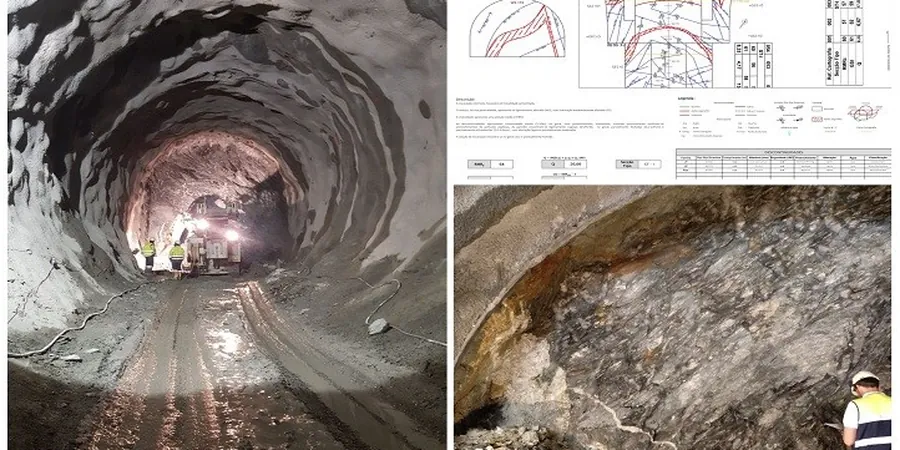
A tunnel drive through Chicago's compressible glacial clays can lock a TBM in days if the face pressure is wrong. We've seen it on projects near the Chicago River where contractors underestimated the sensitivity of the Blodgett till. The city sits on up to 30 meters of soft lacustrine deposits over dolomite bedrock. That sequence demands a geotechnical analysis for soft soil tunnels that goes beyond standard borehole logs. Our team runs CU triaxial suites on undisturbed Shelby tube samples to define undrained shear strength profiles, then cross-checks with CPT pore pressure dissipation tests to confirm hydraulic conductivity boundaries. For tunnel alignments under the Loop, we also integrate excavation monitoring data from adjacent basements to calibrate settlement predictions before the cutterhead advances.
Chicago's soft clay can lose 60% of its undrained shear strength when remolded during tunneling. Face pressure control isn't optional—it's survival.
Top questions
What soil units cause the most problems for tunneling in Chicago?
The compressible Park Ridge till and the underlying lacustrine clays are the most challenging. These units are saturated, moderately sensitive, and lose significant strength when disturbed. Mixed-face conditions where the tunnel invert hits dolomite bedrock while the crown remains in soft clay create additional steering and face stability problems.
How much does a geotechnical analysis for a soft ground tunnel in Chicago cost?
A complete investigation program—including deep borings, undisturbed sampling, triaxial testing, consolidation tests, and CPTu soundings—typically ranges from US$3,640 for a preliminary alignment study to US$18,760 for a full design-phase characterization with settlement modeling. The final scope depends on tunnel length, depth, and proximity to sensitive structures.
Do you evaluate liquefaction risk for tunnels in Chicago?
Liquefaction is generally not a primary concern for Chicago's clay-dominated geology because cohesive soils are not susceptible. However, we do evaluate cyclic softening in silt lenses and check for loose granular deposits in buried valley fills near the lakefront where liquefaction could affect shaft stability.
Which design parameters matter most for an EPB machine in Chicago clays?
Undrained shear strength and sensitivity are the critical inputs. Face support pressure must balance the active earth pressure without exceeding the passive limit. We also provide the coefficient of consolidation to estimate pore pressure dissipation time, which directly affects screw conveyor torque and conditioning foam injection rates.