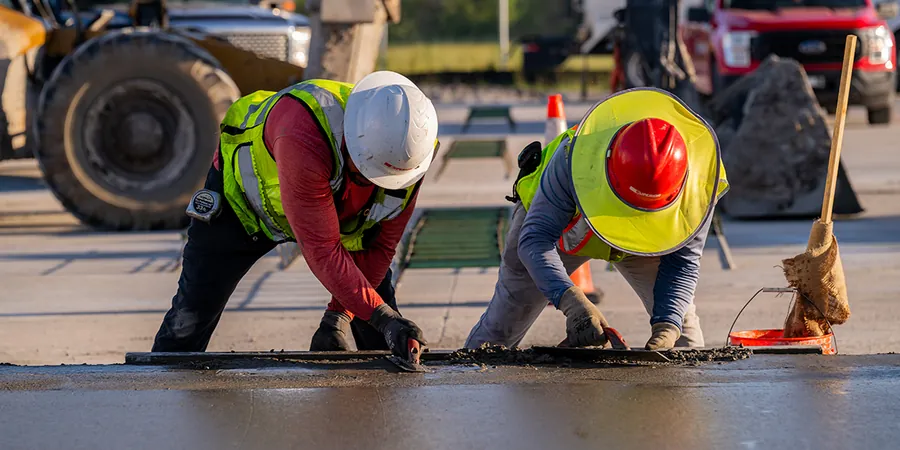
Chicago sits on roughly 60 feet of glacial till and lakebed deposits, but the real story is the top 4 feet. That’s where the freeze-thaw battle happens. In a city with over 2.7 million people and a winter that can drop below 0°F, a rigid pavement slab is only as good as its subgrade. We’ve seen jointed plain concrete pavements fail within three seasons because the base course wasn't drained properly. The problem isn’t the concrete mix — it’s almost always water trapped in the granular layer beneath. Our design approach forces us to think like a drainage engineer first and a pavement engineer second. For city arterials like Western Avenue, we tie the structural slab design directly to the subgrade modulus from CPT data so the thickness isn’t just a table lookup — it’s a response to what’s actually under the grade line.
In Chicago, a rigid pavement joint shouldn’t just control cracking — it has to manage a 100°F temperature swing between January and July.
Process overview
Comparing a project near the Loop versus one out by O'Hare, the subgrade tells two completely different stories. Downtown, we’re on dense glacial till — stiff, overconsolidated, and generally predictable. Out west, you hit compressible silty clays that lose strength fast when saturated. For a recent industrial yard in Elk Grove Village, we specified a 9-inch slab on a cement-treated base to bridge the weak spots. Around the Stevenson Expressway corridor, we often deal with urban fill riddled with old foundations. That’s where a slab-on-grade stops being a straightforward design and becomes a structural element spanning voids. We size dowel bars using ACPA’s load transfer models, but we adjust joint spacing for Chicago’s extreme temperature swings. A 15-foot joint spacing that works fine in Tennessee will buckle here by August. We also spec air-entrained, low-shrinkage mixes as standard — anything less is gambling with the freeze-thaw cycle.
Local context
A five-story mixed-use building on a corner lot in Logan Square was set to open by fall, but the contractor poured the parking apron on saturated clay without drainage. By the following March, 60% of the slabs had mid-panel cracks. The cause wasn’t the concrete — it was frost heave lifting the edges and heavy refuse trucks finishing the job. The repair cost exceeded $80,000, plus lost revenue during the peak holiday season. This scenario repeats across Chicago neighborhoods where groundwater sits just 3 to 5 feet below the surface. Without a positive drainage layer and properly sealed joints, water enters the base, freezes, and jacks the slab apart. Our risk mitigation always includes a subdrain plan and a requirement for proof-rolling the subgrade before any formwork goes down. If the subgrade pumps, we stop and stabilize — no exceptions.
Top questions
What's the typical cost range for rigid pavement design on a commercial lot in Chicago?
For most commercial and light industrial projects in the Chicago area, the engineering design fee for a rigid pavement package runs between US$1,650 and US$6,570. The spread depends on the number of subgrade borings, the complexity of the joint layout, and whether we're dealing with existing urban fill or virgin glacial till.
How does Chicago's winter affect rigid pavement performance?
The freeze-thaw cycle is the dominant factor. Water trapped in the base course expands roughly 9% when it freezes, lifting slab corners. When it thaws, the slab settles unevenly. This cycle repeats 30 to 40 times per winter, causing pumping and progressive cracking. We design the drainage layer and joint sealant system specifically to break this cycle.
What's the difference between IDOT specs and commercial rigid pavement design?
IDOT specs focus on high-cycle fatigue for interstate traffic and often require thicker slabs and wider shoulders. Commercial projects — like warehouse floors or parking lots — can use ACPA StreetPave methods, which are more cost-sensitive but still demand the same level of subgrade preparation. We adapt the spec to the use case, not the other way around.
How do you handle soft lake plain clays under a rigid pavement?
We often specify a cement-treated base or geogrid-reinforced aggregate layer to bridge the weak subgrade. In extreme cases, we'll undercut 2 to 3 feet of soft clay and replace it with compacted granular fill. The goal is to create a working platform that doesn't pump or deform under repeated wheel loads.