← Home · Laboratory

Precision Grain Size Analysis for Chicago’s Glacial Soils

Together, we solve the challenges of tomorrow.

LEARN MORE →

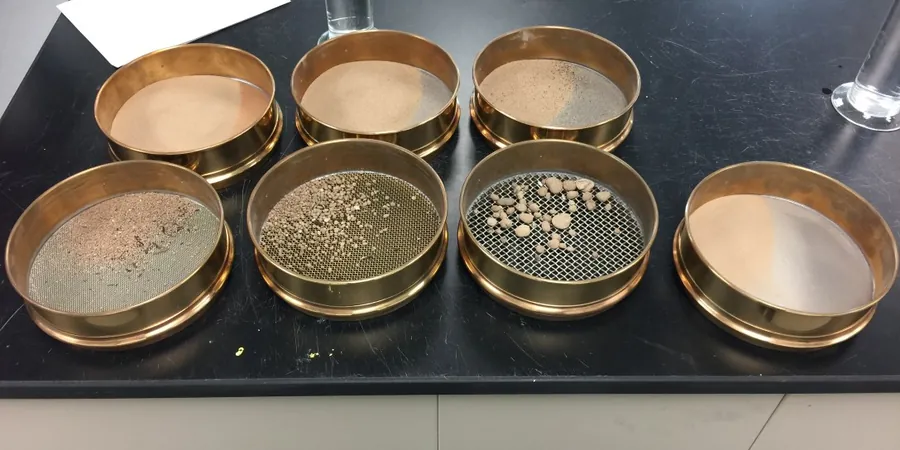
Our mechanical shakers in the Chicago lab run ASTM E11 sieves from 4.75 mm down to 75 microns, stacked on a Tyler Ro-Tap that reproduces the circular and tapping motion specified by ASTM D422. For the fines fraction passing the No. 200 sieve, the hydrometer test follows ASTM D7928 with a 152H soil hydrometer settling in a temperature-controlled cylinder at 20 °C. Because Chicago’s subsoil shifts from sandy outwash near the Des Plaines River to the compressible Blodgett silty clay found downtown, the combined sieve-plus-hydrometer curve is the only reliable way to assign a USCS group symbol for foundation design. We pair the grain size distribution with Atterberg limits when the fines are plastic, and run the Proctor compaction test on the same borrow material to lock in moisture-density specs before fill placement.

A single grain size curve on Chicago’s varved clay can separate a lean CL from a fat CH — and that one letter changes the entire foundation design.

Methodology and scope

Chicago’s post-Fire rebuilding in the 1870s raised street grades by several feet, burying old basements and creating an artificial fill layer that still complicates shallow excavation today. Beneath that urban crust lies a sequence of Wisconsin-age glacial deposits: stiff silty clay till, lake-bottom varved clays, and outwash sand lenses that can carry perched groundwater. A grain size curve pinpoints exactly where those transitions happen. When the hydrometer reading shows 60 percent clay fraction in a boring from Streeterville, the structural team knows they are dealing with a CH material that will move with seasonal moisture — and that requires a different bearing capacity check than the well-graded sand we log near the Calumet River. For deep foundations, we often cross-check the gradation log with an SPT drilling log to correlate N-values with soil type down to bedrock depth, which in the Loop sits roughly 80 to 100 feet below grade.
Precision Grain Size Analysis for Chicago’s Glacial Soils
Technical reference image — Chicago

Local considerations

Lake Michigan’s shoreline moisture drives a seasonal shrink-swell cycle in Chicago’s near-surface clay that masks the true gradation if the sample is not oven-dried correctly. A hydrometer test run on air-dried material can misclassify a CH as a CL by under-reading the clay fraction — a mistake that leads to undersized footings and long-term differential settlement. In winter, frozen samples from open-pit test pits near O’Hare can break the grain structure during thawing; our lab follows ASTM D421 dry-preparation protocol to preserve the original particle size distribution. Twin-arch tunnel projects like the McCook Reservoir stormwater system demand precise gradation of the dolomitic silts to predict erodibility, and we have seen cutoff curves shift a whole USCS class just by correcting for organic content on the hydrometer reading.

Need a geotechnical assessment?

Reply within 24h.

Email: contact@geotechnicalengineering1.org

Technical parameters

ParameterTypical value
Sieve stack range75 mm to 75 µm (No. 200)
Hydrometer standardASTM D7928, 152H hydrometer
Dispersion methodSodium hexametaphosphate, mechanical stirrer
Sample mass (sieve)500 g min. for sands, 200 g for fines
Reporting unitsPercent retained and passing, D10-D30-D60
Temperature controlConstant bath at 20 ± 0.5 °C
USCS classificationASTM D2487, group symbol and name

Associated technical services

01

Combined Sieve and Hydrometer Package

One sample, one unified curve. We wash the material over the No. 200 sieve, dry and shake the retained fraction through eight sieves, and run the hydrometer on the minus-200 suspension. Delivered as a gradation chart with Cu, Cc, and USCS symbol on a stamped PDF.

02

Hydrometer-Only Fines Analysis

For Chicago Basin lacustrine clays where the sand fraction is negligible, we skip the coarse sieve and go straight to ASTM D7928 sedimentation. This cut saves turnaround time on projects like the Ashland Avenue BRT corridor where multiple boreholes hit the same clay unit.

Applicable standards

ASTM D422-63(2007), ASTM D6913/D6913M-17, ASTM D7928-21, ASTM D2487-17

Frequently asked questions

How much does a grain size analysis cost in Chicago?

A standard combined sieve and hydrometer test on one sample typically runs between US$100 and US$200 in the Chicago market, depending on turnaround speed and whether the sample needs special drying or organic content correction. Rush delivery and IDOT-format reporting may push it toward the upper end of that range.

Which ASTM standard do you follow for the hydrometer portion?

We run the hydrometer analysis per ASTM D7928, using a 152H soil hydrometer in a sedimentation cylinder kept at 20 °C. Readings are taken at 0.5, 1, 2, 4, 8, 15, 30, 60, 120, 240, and 1440 minutes, and the final curve is corrected for meniscus, temperature, and dispersing agent.

Do I need a hydrometer test or just a sieve analysis for my Chicago project?

If your boring log shows more than 12 percent passing the No. 200 sieve, a hydrometer test is required to classify the fines correctly under ASTM D2487. In Chicago’s lake-plain clays, that threshold is almost always exceeded once you are below the fill layer, so the combined test is the standard recommendation for any foundation investigation.
Location and service area

We serve projects across Chicago and its metropolitan area.

View larger map