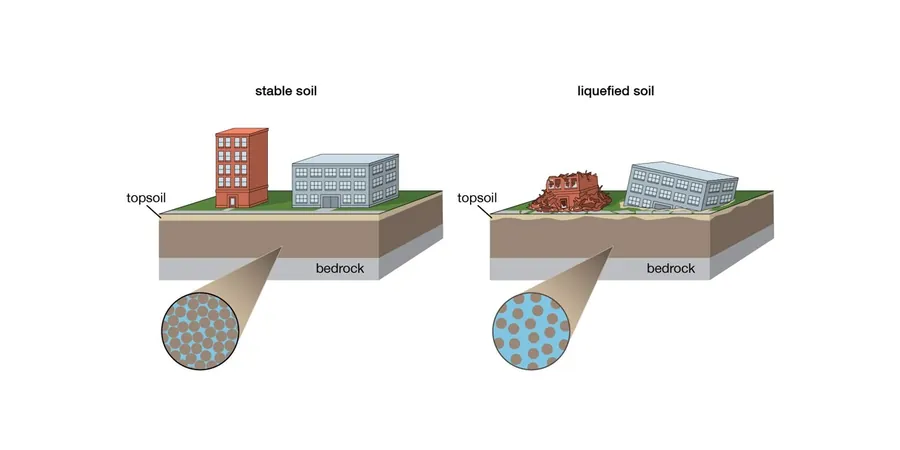
Chicago sits on a glacial lake plain with a shallow water table that rarely drops below 2 meters in the downtown area. The city's subsurface is dominated by compressible clays, but the old shoreline deposits and infilled river channels contain loose silty sands and fine sands that demand a rigorous soil liquefaction analysis. The 1968 magnitude 5.4 Illinois earthquake—centered roughly 120 miles south—reminded local engineers that intraplate seismicity is real, even in the Midwest. Our laboratory runs SPT-based liquefaction triggering procedures using NCEER simplified methods, correcting blow counts for energy ratio, overburden, and fines content. Each sample is classified under ASTM D2487, and we run Atterberg limits and grain-size distributions to confirm whether the fine fraction is plastic silt or non-plastic silt—a distinction that changes the CRR curve dramatically. For critical infrastructure near the Chicago River, we supplement field data with cyclic triaxial testing when the project requires site-specific CRR curves instead of empirical correlations.
Fines content and plasticity separate a non-liquefiable silty clay from a contractive silt that can trigger flow failure at 15 percent strain in under 10 cycles.
Local context
Chicago rebuilt itself upward after the 1871 fire, but the underground remained a patchwork of filled depressions, old dock pilings, and buried debris. When modern high-rises anchor into hardpan or dolomite bedrock at minus 80 feet, the liquefaction risk concentrates in the upper 30 to 50 feet where loose alluvial sands and silts predominate. A soil liquefaction analysis here must account for the city's low-seismicity paradox: PGA values are modest, but the recurrence of a New Madrid-type event—though distant—produces long-period shaking that can amplify in soft lakebed deposits. We run factor-of-safety profiles for each borehole, flagging layers where FSL drops below 1.1. In zones along the Chicago Sanitary and Ship Canal, lateral spreading displacement estimates follow the empirical models of Youd & Bartlett (2002), calibrated with local SPT data.
Relevant standards
ASTM D1586-18 Standard Test Method for Standard Penetration Test (SPT) and Split-Barrel Sampling of Soils, NCEER (Youd & Idriss 2001) Liquefaction Resistance of Soils: Summary Report, ASCE 7-22 Minimum Design Loads and Associated Criteria for Buildings and Other Structures, ASTM D4318-17e1 Standard Test Methods for Liquid Limit, Plastic Limit, and Plasticity Index of Soils, IBC 2021 Section 1803 Geotechnical Investigations
Top questions
How much does a soil liquefaction analysis cost for a Chicago project?
A complete package—SPT-based triggering, fines characterization, and reporting for a single borehole with 3–4 liquefiable layers—runs between US$2,800 and US$4,360. The range depends on whether cyclic triaxial testing is added and how many samples require Atterberg limits.
Which SPT corrections does the lab apply for Chicago glacial soils?
We correct raw N-values for hammer energy ratio (typically 45–60% on safety hammers), rod length, sampler liner presence, borehole diameter, and overburden pressure. The final N1,60 is then adjusted for fines content using the NCEER-recommended procedure. All correction factors are reported transparently in the liquefaction summary table.
At what depth do you evaluate liquefaction potential in downtown Chicago?
Liquefaction triggering is evaluated from the groundwater table down to roughly 50 feet or the top of hardpan, whichever is shallower. Most susceptible layers in the Chicago area are found between 8 and 35 feet, corresponding to post-glacial lake sand deposits and alluvial channel fills mapped by the Illinois State Geological Survey.