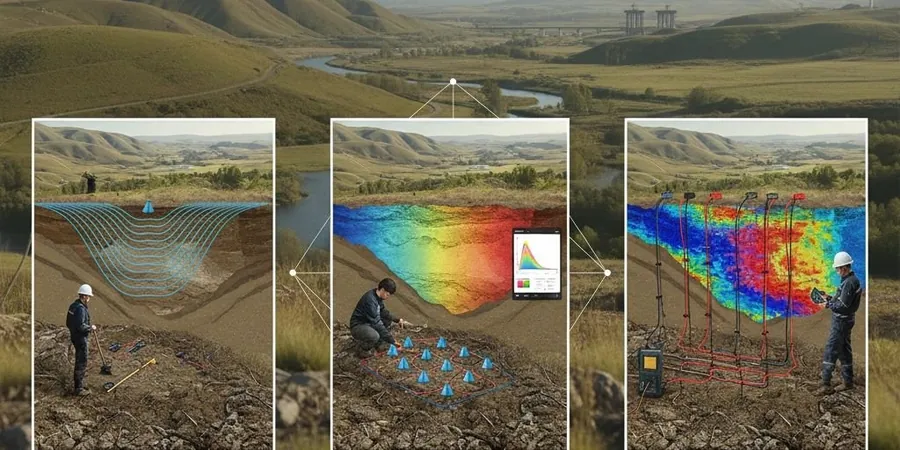
Seismic engineering in Chicago occupies a unique position within the broader field of geotechnical and structural design. While the city is not situated near an active tectonic plate boundary like California, it is subject to a different kind of seismic hazard: intraplate earthquakes. These events, originating from deep and often poorly understood faults like the Wabash Valley Seismic Zone to the south, can propagate energy efficiently through the stiff bedrock of the Midwest, affecting a vast area. A comprehensive seismic strategy here must therefore address not just the immediate shaking but also the profound amplification effects caused by the region's complex glacial geology, moving beyond a simple check of peak ground acceleration to a nuanced understanding of site-specific response.
Chicago's subsurface is a direct legacy of the Wisconsinan glaciation, creating a heterogeneous deposit that critically influences seismic wave behavior. The downtown area, particularly along Michigan Avenue and the Loop, is famously underlain by a thick sequence of soft, compressible, and water-saturated lacustrine clays. These deposits are highly susceptible to cyclic loading, making a rigorous soil liquefaction analysis an indispensable component of any major project. The stark contrast in stiffness between these soft soils and the underlying dolomitic bedrock can trap seismic energy, significantly amplifying ground motion and shaking duration at the surface in ways that standard building codes might not fully capture without detailed investigation.
The primary regulatory framework governing seismic design in Chicago is the Chicago Building Code, which largely adopts the structural provisions of the International Building Code (IBC) with locally specific amendments. Designers must adhere to the standards set forth by the American Society of Civil Engineers in ASCE 7, 'Minimum Design Loads and Associated Criteria for Buildings and Other Structures.' This standard utilizes a site-specific response spectrum based on the mapped Risk-Targeted Maximum Considered Earthquake (MCER) ground motions. A critical step in this process is the Site Class determination, which, for Chicago's prevalent soft clay profiles (often Site Class E or F), demands a rigorous site-specific ground motion analysis rather than relying on default spectral accelerations, a requirement that often triggers the need for a detailed seismic microzonation study.
The types of projects in Chicago that mandate a sophisticated seismic approach extend well beyond high-rise towers. Any structure assigned to Risk Category III or IV, such as hospitals, emergency response facilities, and schools, requires an elevated level of analysis. Furthermore, the design of critical infrastructure—including bridges, underground transit systems like the CTA tunnels, and lakefront water intake structures—demands a performance-based design philosophy. For these essential facilities, engineers are increasingly turning to advanced protective systems, and base isolation seismic design is becoming a recognized method to decouple the superstructure from the most damaging ground motions, ensuring operational continuity immediately after a design-level earthquake.
Yes, Chicago faces a genuine, albeit different, seismic risk. The city is vulnerable to powerful intraplate earthquakes originating from zones like the New Madrid and Wabash Valley seismic areas. The stiff bedrock of the North American craton transmits seismic waves very efficiently over long distances with little attenuation, meaning a major event hundreds of miles away can still generate significant shaking in Chicago.
Chicago's deep glacial and lacustrine clay deposits are a dominant factor in seismic design. These soft, saturated soils can amplify ground motions significantly compared to bedrock sites, a phenomenon known as site amplification. They are also evaluated for cyclic softening and liquefaction potential. This often results in a Site Class E or F designation, requiring site-specific response analysis instead of using standard code-based spectral accelerations.
A site-specific seismic hazard analysis is a detailed study that develops a design response spectrum tailored to a particular project's subsurface conditions. It is typically required by the Chicago Building Code and ASCE 7 when a structure is located on Site Class D, E, or F soils, or when it is a high-rise or critical facility. This analysis accounts for local soil amplification, basin effects, and the specific seismotectonic setting to create a more accurate ground motion model.
The Chicago Building Code does not explicitly mandate seismic isolation for all critical facilities. However, for essential structures like hospitals and emergency response centers (Risk Category IV), the code requires a high level of performance and structural integrity. Engineers must demonstrate that the design meets strict drift and damage limitation criteria. Base isolation is a highly effective, and often the most economical, solution to achieve the enhanced performance objectives required for immediate post-earthquake occupancy.