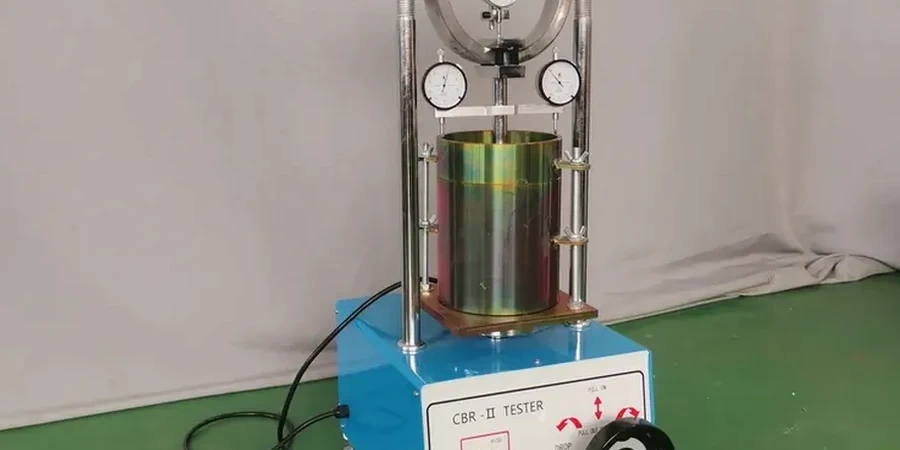
Chicago's pavement sections endure a brutal cycle: subzero winter frost penetration followed by spring thaw saturation over the city's native glacial lake plain clays. The Chicago Department of Transportation (CDOT) and IDOT routinely specify laboratory California Bearing Ratio values to anchor their pavement thickness designs, because a soaked CBR below 3% on a weak silty clay subgrade can trigger a 40% increase in required aggregate base thickness under AASHTO 93 methodology.
That reality drives our laboratory team to run every CBR test with strict adherence to ASTM D1883 and AASHTO T 193 — controlling compaction effort, moisture conditioning, and 4-day soaking to replicate the worst-case drainage scenario beneath Chicago's streets. We complement this with Proctor testing to lock in the moisture-density target before compacting CBR specimens, and we run companion grain-size analysis to correlate bearing capacity with fines content in the region's Wadsworth and Blodgett till formations.
A 1% moisture deviation above optimum during specimen preparation can erase two full points of soaked CBR — and in Chicago's spring groundwater conditions, that margin determines whether a pavement section survives or fails.
Local context
Chicago's geotechnical history is written in its lakebed clays. The city's postwar expressway buildout — the Kennedy, Dan Ryan, Eisenhower — ran directly across compressible glacial till and lacustrine silts that required massive over-excavation where CBR values dipped below 2%. Today, infill development in neighborhoods like Pilsen and Bronzeville routinely uncovers pockets of organic silt from filled-in marshland, where lab CBR results can swing from 8% to under 1% across a single block.
The risk compounds when designers rely on unsoaked CBR values for pavement sections in areas with poor drainage or combined sewer overflow zones. Soaked CBR is the non-negotiable reference in Chicago; skipping the 4-day saturation step can under-predict aggregate thickness by 30-50% and lead to premature rutting after the first freeze-thaw cycle. We also recommend pairing CBR with resilient modulus correlations when the pavement design follows the AASHTOWare Pavement ME methodology, since CBR alone does not capture the stiffness recovery of Chicago clays after spring thaw.
Relevant standards
ASTM D1883-21: Standard Test Method for California Bearing Ratio (CBR) of Laboratory-Compacted Soils, AASHTO T 193-22: Standard Method of Test for the California Bearing Ratio, ASTM D1557-12(2021): Standard Test Methods for Laboratory Compaction Characteristics of Soil Using Modified Effort, IDOT Bureau of Materials and Physical Research: Sampling and Testing Frequency Manual, Section 500, AASHTO R 58: Standard Practice for Dry Preparation of Disturbed Soil and Soil-Aggregate Samples for Test
Top questions
What is the difference between soaked and unsoaked CBR, and which does Chicago require?
Soaked CBR simulates the saturated subgrade condition after prolonged wet weather or spring thaw, while unsoaked CBR reflects the as-compacted strength at field moisture. CDOT and IDOT pavement design manuals require soaked CBR for cohesive subgrade soils because Chicago's high water table and poor-drainage areas produce near-saturated conditions for weeks each spring. Unsoaked CBR is accepted for granular base course materials that drain freely.
How much does a laboratory CBR test cost in the Chicago area?
For a standard three-point soaked CBR determination on remolded subgrade specimens, laboratory fees in the Chicago market typically range from US$130 to US$220 per sample, depending on whether the package includes Proctor compaction curves, swell monitoring, and the number of penetration points. Expedited turnaround or weekend processing may carry a surcharge.
How long does the CBR test take from sample receipt to report?
The physical test sequence runs 5 to 7 working days: 24 hours for specimen preparation and compaction, 96 hours (4 days) for the soaking phase under surcharge, and approximately 2 hours for the penetration run and data reduction. Additional time is required if companion Proctor curves or grain-size analyses are needed prior to CBR specimen fabrication. Rush schedules can compress the soaking period to 48 hours with prior approval.
What CBR value is considered acceptable for Chicago subgrade soils?
IDOT District 1 typically requires a minimum soaked CBR of 3% for untreated cohesive subgrade; values below that trigger subgrade stabilization with lime, cement, or geogrid reinforcement. For granular subbase, the target is 20-30% soaked CBR. Chicago's native Wadsworth till commonly yields soaked CBR values between 2% and 6%, depending on sand lens content and compaction effort, so stabilization is frequent in new construction.