← Home · Investigation

CPT Testing in Chicago: Cone Penetration Data for the Windy City's Subsurface

Together, we solve the challenges of tomorrow.

LEARN MORE →

With Chicago's population surpassing 2.7 million and its skyline constantly reshaping neighborhoods from the Loop to Logan Square, the demand for precise geotechnical data has never been sharper. Beneath the city's iconic architecture lies a complex glacial legacy: a hidden sequence of compressible clays, interbedded silts, and dense tills deposited by Lake Michigan's ancestral advances. A standard borehole log provides snapshots at five-foot intervals, but the CPT cone penetration test captures a continuous, high-resolution profile of soil behavior, revealing thin drainage layers that can dictate settlement timelines on a high-rise project. For engineers working along the Chicago River or near the lakefront, where the ground oscillates between fill, organics, and natural deposits, this uninterrupted record proves essential. Many design teams pair CPT data with a conventional SPT drilling program to correlate cone resistance with blow counts, establishing a solid site-specific model before selecting deep foundations or evaluating seismic demands under the Chicago Building Code.

A continuous CPT profile in Chicago's lake plain clays can reveal a two-inch sand seam that halves the drainage path and cuts settlement time by years.

Methodology and scope

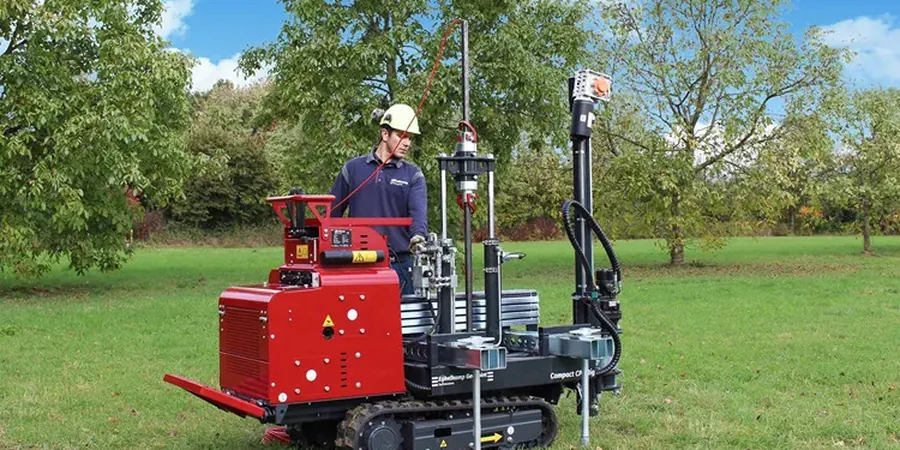
The rig itself arrives on a compact track-mounted carrier that navigates tight alley access in dense wards like Wicker Park without the overhead clearance issues of a traditional drill mast. A hydraulic ram pushes an instrumented conical tip — with a 60-degree apex and a 10 cm² or 15 cm² base area — into the ground at a constant rate of 2 cm per second, while a friction sleeve and pore pressure transducer record data simultaneously. This setup measures cone tip resistance, sleeve friction, and dynamic pore water pressure, allowing the geotechnical team to classify soil type on the fly using the Robertson chart. In Chicago's desiccated crust and underlying glacial till, the friction ratio often signals a sharp transition from stiff clay to hardpan that a split-spoon sampler might miss. Because the test produces no cuttings, it suits urban jobs where contaminated fill from historical industrial uses along the Chicago Sanitary and Ship Canal raises disposal concerns. The resulting digital logs integrate directly with liquefaction analysis software, applying the Youd-Idriss framework to evaluate cyclic stress ratios from a Lake County seismic event.
CPT Testing in Chicago: Cone Penetration Data for the Windy City's Subsurface
Technical reference image — Chicago

Local considerations

Chicago's winter freeze-thaw cycles and summer deluges off Lake Michigan create a moisture regime that swings the upper five feet of soil from saturated to desiccated within a month. A CPT pushed through crusty clay in August may read a qc value 30% higher than the same stratum in April, misleading a foundation engineer who assumes uniform strength with depth. Seasonal perched water trapped above the glacial till also skews pore pressure dissipation curves, complicating the interpretation of consolidation coefficients. Skipping dissipation tests at multiple depths means risking an overestimate of the lakefront clay's drainage rate — a mistake that can delay a tower's post-construction settlement window by six months or more. Our field team records ambient temperature and precipitation history in the CPT log header, helping the project geotechnical engineer apply seasonal corrections to the raw cone resistance before finalizing bearing capacity calculations.

Need a geotechnical assessment?

Reply within 24h.

Email: contact@geotechnicalengineering1.org

Technical parameters

ParameterTypical value
Cone tip resistance (qc)0 to 50 MPa typical for Chicago clays
Sleeve friction (fs)0.001 to 0.5 MPa
Friction ratio (Rf)0.5% to 8% (clay to sand transition)
Pore water pressure (u2)Measured behind cone shoulder
Penetration rate20 mm/s ± 5 mm/s per ASTM D5778
Cone area ratio10 cm² or 15 cm²
Depth capacityUp to 200 ft in soft to medium soils
Soil behavior typeRobertson (1990) normalized SBTn chart

Associated technical services

01

Piezocone Dissipation Testing

Stopping the cone at predetermined depths to record pore pressure decay yields the coefficient of consolidation for Chicago's lake plain clays, a critical input for settlement rate predictions.

02

Seismic CPT (SCPT)

A geophone module behind the cone measures shear wave velocity at one-meter intervals, allowing direct determination of the small-strain shear modulus and site class per ASCE 7-22 without a separate borehole.

03

CPT for Liquefaction Screening

Using normalized cone resistance and friction ratio to evaluate cyclic resistance ratios in sandy lenses within the glacial till, triggered by a design earthquake on the Sandwich Fault Zone.

04

Soil Behavior Type Profiling

Continuous SBTn logs classify the stratigraphy from fill to dolomite bedrock, mapping out the compressible Chicago clay, the Blodgett and Deerfield tills, and any sand stringers that act as drainage boundaries.

Applicable standards

ASTM D5778-20 Standard Test Method for Electronic Friction Cone and Piezocone Penetration Testing of Soils, IBC 2021 Section 1803 Geotechnical Investigations, ASCE 7-22 Chapter 20 Site Classification Procedure, FHWA Geotechnical Engineering Circular No. 5 (CPT guidelines), Robertson & Wride (1998) Liquefaction Evaluation Procedure

Frequently asked questions

What depth can a CPT truck reach in Chicago's glacial soils?

In the soft to medium clays typical of the Chicago lake plain, our 20-ton rig routinely reaches 150 to 200 feet before encountering refusal on the dense dolomite bedrock or the hardpan till. When the cone tip resistance exceeds 50 MPa over several consecutive readings, we stop to avoid damaging the sensors.

How much does CPT testing cost in the Chicago area?

Mobilization and testing for a typical single-day program in Chicago runs between US$180 and US$240 per linear foot, depending on depth, traffic control requirements, and whether we deploy seismic or dissipation modules. A full day with SCPT and multiple dissipation tests will trend toward the upper end of that range.

Can CPT replace a standard boring for foundation design?

CPT provides continuous, repeatable data that often surpasses SPT-based sampling for stratigraphic detail and soil parameter derivation, but it does not recover physical samples. Most Chicago projects use CPT to supplement a reduced number of boreholes: the borings provide samples for index testing, while the CPT fills in the gaps and captures thin layers that a split spoon might miss.

How do you handle fill with brick fragments and debris common in Chicago?

Urban fill containing demolition debris can damage a cone tip or cause premature refusal. We pre-drill through known fill zones using a hollow-stem auger to a depth of about 10 to 15 feet, then push the cone from the bottom of the auger into the natural soils below, protecting the sensors and ensuring clean data in the zones that matter for bearing capacity.

What deliverables do I receive after a CPT program?

You receive digital logs in PDF and Excel format showing cone tip resistance, sleeve friction, friction ratio, and pore pressure versus depth, along with daily field reports noting weather, refusal depths, and any anomalies. If you ordered seismic testing, we also supply shear wave velocity profiles and the corresponding ASCE 7 site class determination.
Location and service area

We serve projects across Chicago and its metropolitan area.

View larger map