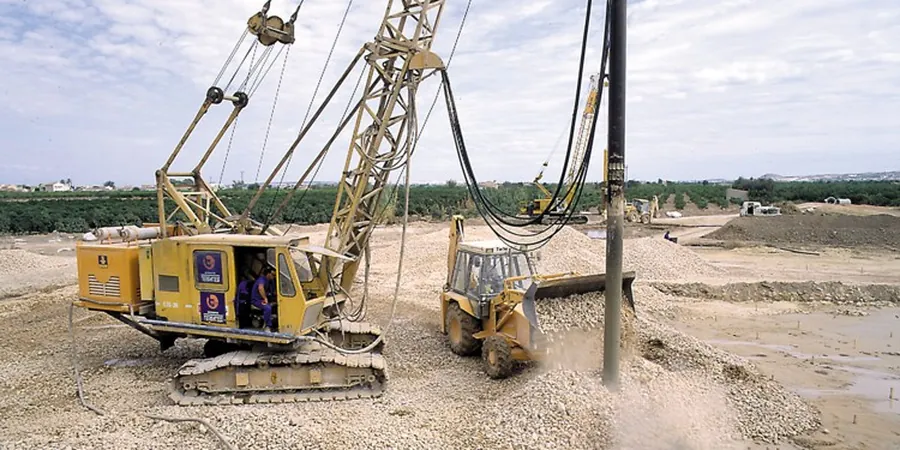
Chicago's skyline rests on a glacial legacy that keeps geotechnical engineers on their toes. Beneath the Loop and sprawling out into neighborhoods, up to 40 meters of soft, compressible clay—the Lake Michigan lobe till—lies between grade and competent rock. When you propose a six-story building near the river or a warehouse in the old industrial corridors, conventional footings often fall short. That's where stone column design comes in. We use vibro-replacement to transfer loads through the weak stuff and into the deeper, stiffer strata. The approach works. We've applied it from Goose Island to the Calumet River basin, where fill thickness varies wildly over short distances. Many of these projects start with a CPT test to map the clay sensitivity before we even size the columns, because the local urban fill can hide organics that turn a routine job into a tricky one.
In Chicago's soft clays, a well-designed stone column transfers the load to stiffer ground while the drainage it creates accelerates consolidation under the structure.
Process overview
Compare a site in Streeterville with one out near Midway Airport. Streeterville sits on old lake fill—sand mixed with debris, highly variable, drains fast but settles unevenly. Midway's underlying clays are deeper and more uniform, but they consolidate slowly under load. Your stone column design has to account for those differences. In Streeterville we often combine columns with a load-transfer platform built from well-graded
grain size material. Out near Midway, the columns themselves are longer and we pay more attention to radial drainage to speed up consolidation. We run the numbers using cavity expansion theory and check settlement with Priebe's method, but the real key is the field verification. A
sand cone density test on the granular mattress tells us if the platform is really doing its job before the first structural concrete goes in. The design isn't just about column diameter and spacing—it's about understanding how the whole system behaves in the specific Chicago subsurface, from the crushed stone up to the floor slab.
Local context
IBC Chapter 18 and the FHWA Improvement Manual set the framework, but Chicago's unique stratigraphy makes compliance a live challenge. The biggest risk we see is underestimating the long-term settlement of the untreated matrix between columns. In a city where the clay can creep for decades, a design that only looks at bearing capacity misses the point. The second risk is installation quality—if the vibroflot doesn't properly compact the stone at depth, you've just created a weak vertical drain. We've seen this happen on sites near the Sanitary and Ship Canal, where the clay is extra sensitive. Another local hazard is encountering buried timber foundations or old bulkheads from the 19th century, which can disrupt column layout and require real-time design changes in the field.
Top questions
What types of Chicago soils are candidates for stone columns?
The soft, compressible clays of the Lake Michigan lobe and loose urban fills found across the city are ideal candidates. We typically target soils with undrained shear strength above 15 kPa. Sites near the river corridors or in former industrial zones like Pilsen often have these conditions, where the natural clay is too weak for spread footings but strong enough to provide lateral confinement to the stone column during installation.
How long does it take to see consolidation after stone column installation in Chicago?
That depends on the clay's permeability, but in many Chicago neighborhoods the columns act as vertical drains that can cut primary consolidation time from years to months. On a typical site with 10 meters of clay, we often see 90% consolidation within 3 to 6 months after loading begins. The drainage path is effectively reduced to half the column spacing, which makes a dramatic difference compared to untreated clay.
What's the cost range for stone column design and installation in Chicago?
For a typical commercial project in the Chicago area, the combined design and installation cost ranges from US$1,610 to US$4,890 per column, depending on depth, diameter, and stone type. A full site with mobilization, platform construction, and verification testing will scale from that unit cost. We provide a detailed estimate after reviewing your geotechnical report.
Can stone columns be installed right next to existing foundations in Chicago?
Yes, but it requires careful sequencing and monitoring. In dense areas like Lincoln Park or Lakeview, we often install columns within a few feet of existing buildings. We use pre-construction condition surveys, vibration monitoring with seismographs, and sometimes pre-drilling through hard upper layers to reduce lateral displacement. The design must account for the additional surcharge from the adjacent structure to avoid overloading the untreated soil between columns.