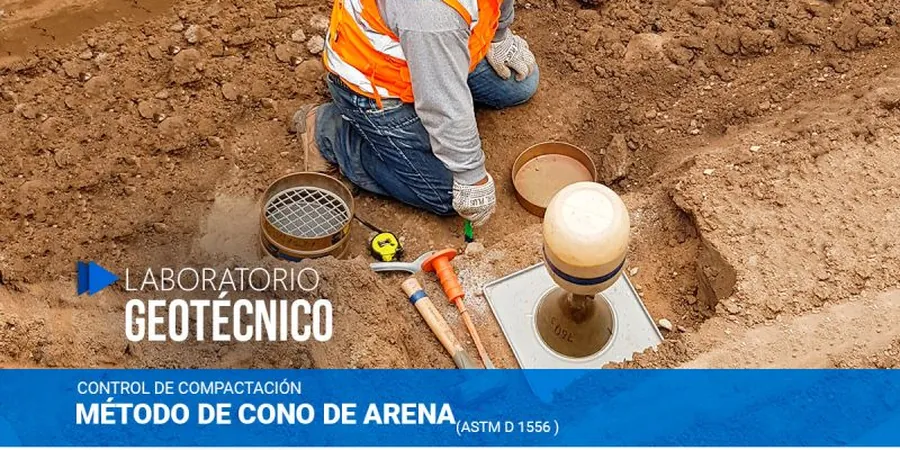
Chicago sits on a base of glacial till and lacustrine clay left by Lake Chicago, and that means compaction control is never straightforward. The upper five to ten feet of urban fill in the Loop and surrounding wards is a mix of sand, demolition debris, and silty clays that densify unpredictably under load. We run the sand cone density test directly on active backfill lifts so the contractor gets a wet density number within fifteen minutes, not the next day. Because the city’s water table can be as shallow as six feet below grade in areas like Streeterville, moisture correction is part of every reading we take. With more than a hundred high-rise and infrastructure projects logged across Cook County, our crews know that a single uncompacted lift under a plaza or a retaining wall will telegraph straight into the concrete work above it.
A single sand cone test on untreated backfill tells you more about future settlement than twenty nuclear gauge scans on the same lift.
Process overview
On a recent 18-story residential job near the Chicago River, the structural engineer called for 95 percent modified Proctor density on the elevator pit backfill, and the access was barely four feet wide between the secant wall and a neighboring party wall. The sand cone method was the only practical option because a nuclear gauge would have given false readings off the adjacent steel reinforcement and the confined space made plate-load testing impossible.
We follow ASTM D1556 to the letter: calibrated Ottawa sand, a base plate keyed into the surface, and a controlled pour from the jar through the valve. The excavated material goes into a sealed bag and runs to our in-house lab for moisture content under ASTM D2216. For granular fills with less than 10 percent fines, we often pair the density reading with a
Proctor curve that was built from the exact borrow source, not a generic library curve, because Chicago’s sand sources from the Lake Michigan shore can shift their optimum moisture point by two or three points between deliveries.
Local context
The mistake we see repeated in Chicago is relying on the sand cone test in coarse open-graded aggregate backfill where the sand infiltrates the voids and the volume calculation becomes meaningless. On a West Loop parking garage, a contractor ran sand cone tests on CA-7 stone without a geotextile liner and got density readings that passed at 98 percent, but post-construction settlement in the adjacent sidewalk reached two inches within a year. The test was valid per the standard, but the material was wrong for the method. We flag this during the pre-construction meeting and recommend a different verification approach for open-graded drainage layers, typically a method spec with lift thickness and compactor passes tied to a test strip. When the material is suitable — silty sand, clayey sand, crushed limestone road base — the sand cone method gives a direct volume-versus-mass measurement that no indirect method can match for legal defensibility in a dispute.
Relevant standards
ASTM D1556 – Standard Test Method for Density and Unit Weight of Soil in Place by Sand-Cone Method, ASTM D698 – Standard Test Methods for Laboratory Compaction Characteristics of Soil Using Standard Effort, ASTM D1557 – Standard Test Methods for Laboratory Compaction Characteristics of Soil Using Modified Effort, ASTM D2216 – Standard Test Methods for Laboratory Determination of Water (Moisture) Content of Soil and Rock by Mass, AASHTO T 191 – Density of Soil In-Place by the Sand-Cone Method, Chicago Building Code Section 1804 – Excavation, Grading, and Fill
Top questions
What does a field density test using the sand cone method actually cost in Chicago?
A single ASTM D1556 sand cone test on a prepared lift in the Chicago area typically runs between US$80 and US$160, depending on whether the engineer needs lab moisture determination (ASTM D2216) and whether the Proctor curve already exists. Mobilization inside the city, especially in the Loop with restricted loading zones and union site requirements, adds a separate line item that we quote per visit.
How many sand cone tests does the Chicago Building Code require per lift?
The code itself points to the geotechnical engineer’s specification. In practice, most Chicago specs call for one field density test per 2,500 square feet per compacted lift, with additional tests at utility trench crossings and around structures. We always match the frequency to the project’s special inspection requirements filed with the Department of Buildings.
Can the sand cone method be used in wet Chicago clay?
Yes, provided the fill is not saturated to the point of pumping. Chicago’s lacustrine clays can hold moisture near the plastic limit, and the sand cone test works as long as the excavation holds its shape. We run a parallel moisture content sample and apply the correction to dry density; if the hole collapses, we move to a drive-cylinder method or recommend waiting for the lift to dry.
How long does it take to get results from a sand cone test?
Wet density is calculated on site within fifteen minutes. If we use a Speedy moisture meter, the dry density and percent compaction are available before we leave the site. With lab oven moisture (ASTM D2216), the final report is emailed within 24 to 48 hours, which is standard for Chicago projects that require a stamped engineer’s certification.
Is the sand cone test accepted for IDOT and Chicago DOT projects?
Yes. Both IDOT Standard Specifications and Chicago DOT accept ASTM D1556/AASHTO T 191 for earthwork and aggregate base verification. We calibrate the sand daily on site and maintain the calibration records required for agency audits, so the test data holds up during final acceptance.