Chicago's vertical ascent from the ashes of 1871 demanded a deep understanding of what lay beneath the debris. Early engineers quickly learned that the city's dense glacial till and the notoriously compressible Chicago clay—deposited by Lake Michigan's prehistoric shoreline—would dictate every foundation decision from the water tower to the Sears Tower. Today, the Standard Penetration Test remains the first line of defense against differential settlement in a city built on a geological patchwork. Our geotechnical laboratory, operating to ISO 17025 standards, performs SPT borings from the sandy spits of Hyde Park to the silty corridors of the Near West Side, delivering ASTM D1586-compliant N-values that structural engineers use to calibrate bearing capacity. With the city's water table often within 6 to 10 feet of grade, SPT data is critical. We cross-reference these results with Atterberg limits testing on the same split-spoon samples, ensuring that the plasticity characteristics of the native silty clay are fully quantified before any excavation begins.
In Chicago's lakebed clays, a 10% variation in N-value can shift allowable bearing capacity by half a ton per square foot—the difference between a mat foundation and deep piles.
Process overview
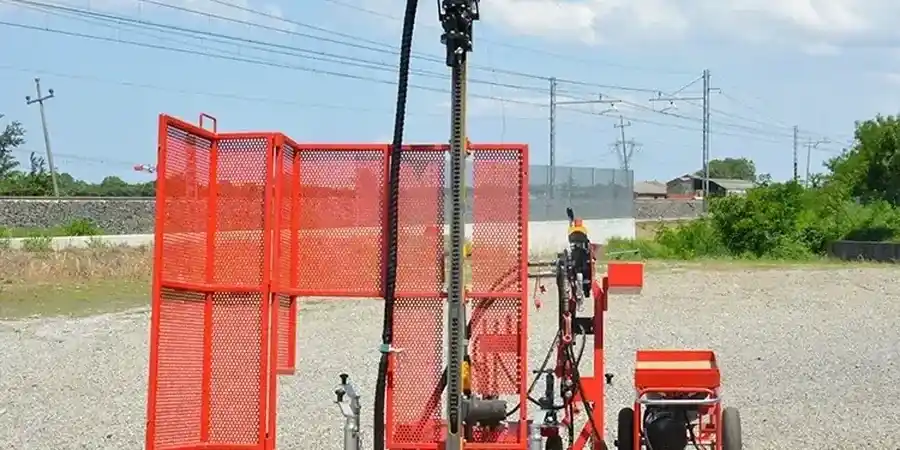
A common mistake among contractors working in Chicago's lakefront neighborhoods is assuming that a uniform N-value profile from a single boring will represent an entire city block. The reality of the city's stratigraphy—alternating lenses of sand, lacustrine clay, and glacial till—means that SPT refusal can occur at 25 feet on one corner and at 50 feet on the next. Our field crews execute the test with a 140-pound safety hammer and a calibrated cathead-rope system, carefully recording blow counts for each 6-inch increment. We don't just report N60 values: we correct for overburden pressure and energy efficiency, providing a corrected (N1)60 profile that feeds directly into liquefaction assessments per Youd & Idriss (2001) procedures. For deep foundation projects, we coordinate SPT borings with continuous sampling through the compressible Blodgett and Park Ridge formations, ensuring that the transition to the hardpan till is clearly identified. The data package includes grain-size distribution notes per ASTM D2487, because knowing whether a refusal zone is boulder-laced till or a thin limestone lens changes the piling contractor's entire approach.
Top questions
What depth of SPT boring is typically required for a mid-rise building in Chicago's Loop?
For a typical 8- to 12-story structure in the Loop, SPT borings extend to 60-80 feet or until hardpan till refusal. The Chicago Building Code requires that borings penetrate through all compressible clay layers—primarily the Blodgett and Park Ridge formations—and terminate in competent glacial till with N-values consistently above 50 blows per foot.
How much does an SPT boring program cost for a standard Chicago residential lot?
For a standard 25x125-foot Chicago residential lot requiring two SPT borings to 30 feet depth, the cost ranges from US$620 to US$780 per boring, depending on access and traffic control requirements. This includes the drilling crew, split-spoon sampling at 5-foot intervals, N-value logging, and the signed geotechnical report.
How do you handle SPT refusal on boulders in Chicago's glacial till?
When SPT refusal occurs on a boulder within the till, we log the N-value as '50/6 inches' or less per ASTM D1586 and note the refusal condition. We then offset the borehole by approximately 3 feet and re-drill to confirm whether the refusal was an isolated boulder or the top of a continuous hardpan layer. Core barrel sampling may be substituted if rock is encountered.
Are Chicago SPT results corrected for the water table in sandy soils?
Yes, all SPT N-values in granular soils below the groundwater table are corrected for reduced efficiency due to pore pressure effects. We apply the Terzaghi-Peck correction for saturated fine sands and silty sands, and report both raw N and corrected N60 values. For liquefaction assessments, we further normalize to (N1)60 following the NCEER workshop recommendations.