Chicago's relentless expansion from a marshy trading post into a steel-and-glass metropolis owes much to the engineering that tamed its challenging lake plain. Beneath the Loop and its sprawling suburbs lie thick sequences of loose sands, silty clays, and—perhaps most critically—vast pockets of uncontrolled urban fill from the post-fire rebuilding era. In our experience across projects from the South Side industrial corridors to high-rise foundations near the Chicago River, designing effective Improvement here demands more than standard compaction. The granular units of the Lake Michigan shoreline and the ancient beach ridges respond well to deep densification, but only when the vibrocompaction program is calibrated to the local grain-size distribution and the water table's seasonal fluctuations. We combine site-specific CPT testing logs with historic boring data to map target zones where vibratory energy can reliably increase relative density beyond 70%, transforming these compressible soils into a competent bearing stratum before structural loads are applied.
In Chicago's lake plain, a vibrocompaction grid spaced at 8 to 12 feet on center routinely delivers a densification radius that bridges loose sand pockets and old sewer trench backfill in a single pass.
Process overview
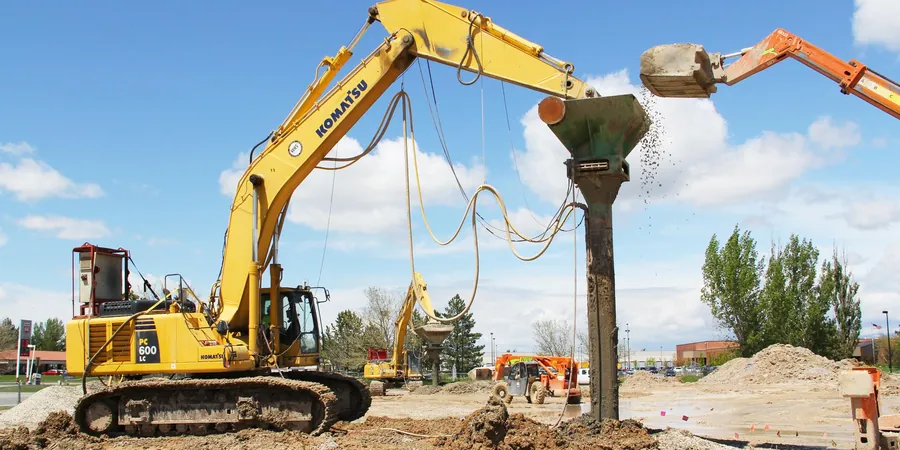
The heart of the operation on a Chicago site typically involves an electric or hydraulic vibrator suspended from a crawler crane, with a probe diameter between 12 and 18 inches—sized to match the gradation of the local beach sands and the occasional gravel lenses left by glacial outwash. The probe's eccentric weight generates horizontal centrifugal forces that rearrange grain-to-grain contacts, expelling pore water and allowing the matrix to collapse into a denser state. Water jets at the tip, fed by a 4- to 6-inch supply line, assist penetration through the crust of stiff clay that often caps the loose sand layers in former industrial yards. We monitor amperage draw, penetration rate, and settlement of the surrounding ground surface in real time; a consistent drop in power consumption paired with a measurable crater around the probe tells us the sand is locking up properly. For fills containing scattered brick bats or timber remnants—a signature of Chicago's debris-filled history—we often pre-drill through obstructions so the vibrator can reach the clean sand below without damaging the probe's nose cone.
Local context
Chicago sits at roughly 597 feet above sea level on a landscape shaped by glacial Lake Chicago, and the legacy of that lake is a subsurface riddled with loose, saturated sand layers that can liquefy under the long-period shaking expected from a distant New Madrid or Wabash Valley seismic event. The city's last notable earthquake in 1968, a magnitude 5.4 centered in southern Illinois, caused swaying in high-rises but limited ground failure; a repeat of the 1811–1812 New Madrid sequence would be a different story entirely. Without properly designed vibrocompaction, these saturated silty sands can lose effective stress and flow laterally toward the river or the lake, threatening deep excavations, pile-supported structures, and buried utilities. The risk multiplies in areas where 19th-century lake fill was dumped over compressible organic silts: differential settlement between compacted and untreated zones can crack slab-on-grade floors and sever water mains. Our designs explicitly tie compaction depth and energy to the liquefaction susceptibility charts calibrated with standard penetration resistance from adjacent SPT drilling campaigns, ensuring that the densified soil column extends below the critical layer identified in the seismic site response analysis.
Top questions
How much does vibrocompaction design cost for a typical Chicago commercial lot?
Design fees for a mid-size commercial parcel in the Chicago area generally range from US$1,410 to US$5,340, depending on the number of treatment zones, the depth of loose sand, and the level of seismic analysis required by the local building department.
Can vibrocompaction be used next to existing buildings in the Loop?
Yes, but with careful attenuation controls. We set vibration monitoring thresholds at 0.5 in/sec peak particle velocity for historic masonry and 1.0 in/sec for reinforced concrete, and we often reduce probe energy near the property line while tightening the grid to maintain target density.
What verification tests are required after compaction in Chicago?
The Chicago Department of Buildings typically requires a combination of CPT soundings and occasional SPT borings at a frequency of one test per 2,500 square feet of treated area. We also run grain-size checks if the fill contains unexpected debris that could alter the drainage path.
How deep can vibratory probes reach in Chicago's glacial deposits?
Standard rigs handle 45 to 55 feet comfortably through the loose beach sands. When we encounter the dense till layer at depth, penetration slows sharply and we stage the treatment bottom just above that natural hardpan, using it as a confining layer for the densified column.