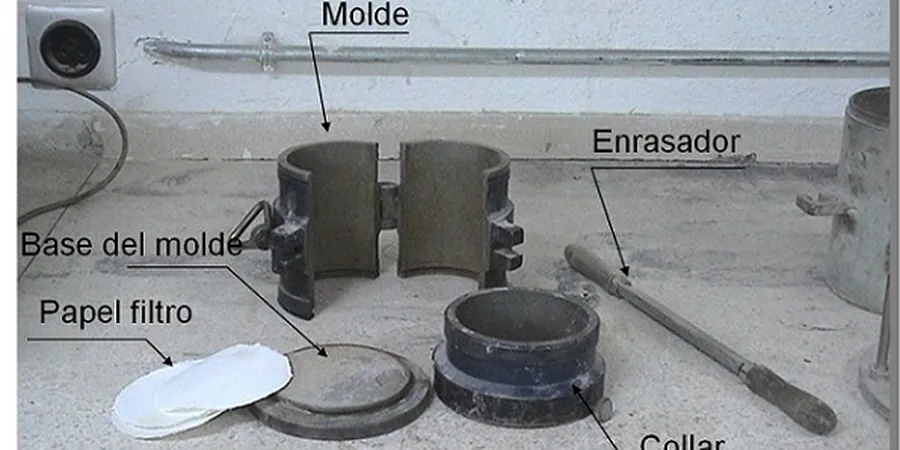
The ground beneath a project in Streeterville tells a vastly different story than a site out near the Des Plaines River corridor. Downtown, you are almost certainly dealing with a century of urban fill over glacial till, while the city's western edges encounter deeper deposits of compressible silty clay. This variability, in a city built on former marshland and shaped by Lake Michigan's fluctuating levels, means a standard compaction specification is never a safe assumption. The Proctor test establishes the maximum dry density and optimum moisture content unique to each soil, providing the target values for field density testing. For Chicago's layered geology, we run both the standard (ASTM D698) and modified (ASTM D1557) procedures, often informed by a preliminary grain size analysis to understand the particle framework that will govern compaction behavior.
A 1% deviation from optimum moisture in Chicago's silty clay fills can halve the achieved relative compaction, turning a compliant lift into a settlement risk.
Local context
Chicago's explosive growth after the Great Fire of 1871 triggered a massive raising of street grades, burying the original ground level under feet of ash, debris, and imported fill. This anthropogenic layer now forms the working platform for countless foundations and pavements. The geotechnical consequence is a soil profile riddled with variable pockets of brick, timber, and cinder that defy uniform compaction. Specifying a Proctor curve without accounting for this heterogeneity often leads to one of two failures: a density specification that is impossible to achieve, or a moisture target that leaves the fill susceptible to frost heave during the city's brutal winters. The Proctor test, therefore, is not just a lab exercise—it is a forensic look at how the soil will behave under the specific energy of the contractor's equipment, ensuring the compacted fill can support everything from a sidewalk vault to a high-rise mat foundation.
Top questions
What is the typical cost range for a Proctor test in Chicago?
For projects in the Chicago area, a standard or modified Proctor test typically ranges from US$100 to US$240 per point, depending on the soil type and whether oversize corrections are needed. Multiple points may be required if the borrow source changes or the soil classification varies significantly across the site.
Which standard should we use for a building pad in the Chicago suburbs?
For a structural building pad on glacial till, the Modified Proctor (ASTM D1557) is almost always required. The higher compactive energy ensures the fill can support foundation loads without excessive settlement, and it matches the compaction effort achievable with the heavy vibratory rollers used by local earthwork contractors.
How do you handle the gravel and cobbles common in Chicago's glacial till during the test?
We follow ASTM D4718 to correct the unit weight and moisture content for oversized particles retained on the No. 4 or 3/4-inch sieve. The material is scalped, and a correction factor is applied to the final density curve. Neglecting this step in till soils can overestimate the field density by several pounds per cubic foot, leading to a false passing grade.