← Home · Laboratory

Triaxial Testing in Chicago: Shear Strength for Deep Foundations

Together, we solve the challenges of tomorrow.

LEARN MORE →

The soil profile shifts completely between the Loop and Streeterville. Downtown Chicago sits on compact glacial till, while the lakeshore east of Michigan Avenue deals with layers of soft, compressible silty clay deposited by Lake Michigan. A standard penetration test gives you N-values, but it doesn't tell you how that clay will behave under the sustained load of a 50-story tower. For that, you need effective stress parameters: friction angle and cohesion. We run triaxial tests on Shelby tube samples extracted from these specific strata. The difference in confining pressure between a 60-foot excavation near the Chicago River and a spread footing in the West Loop changes the entire design envelope. Our lab reports the stress-strain curve you actually need for PLAXIS or FLAC models, often complementing the field data from CPT testing to calibrate the soil behavior type before running the triaxial stage.

A 1-degree error in the effective friction angle can alter a deep excavation's factor of safety by 15% in Chicago's soft clays.
Methodology and scope

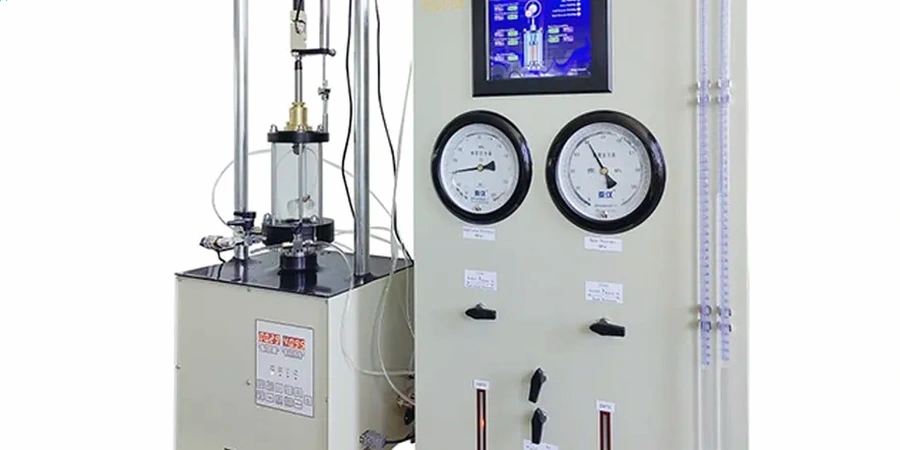
The triaxial cell in our lab is a Bishop-Wesley type with a 20,000-lb load frame. We set it up for Chicago's typical glacial clays and dense tills at confining pressures matching the project depth. A test on Blodgett till will run very differently from one on the Chicago Lake Plain silt. The specimen is trimmed to a 2.8-inch diameter, saturated under back pressure until Skempton's B reaches 0.95 minimum. Then we consolidate it isotropically and shear at a rate slow enough to dissipate pore pressure—usually 0.001 in/min for low-permeability clays. We measure deviator stress and excess pore water pressure continuously. The output is a Mohr-Coulomb envelope from three points. For projects where the till transitions to lacustrine deposits, the Atterberg limits data helps us predict whether the sample will behave as drained or undrained before we even start the shear phase.
Triaxial Testing in Chicago: Shear Strength for Deep Foundations
Technical reference image — Chicago

Local considerations

Chicago's urban expansion after the Great Fire of 1871 pushed construction eastward onto lakefill and old riverbeds. That legacy means any excavation today encounters anthropogenic fill over natural soft clay or loose sand. Designing a foundation on these materials without effective stress parameters is a gamble. A total stress analysis from unconfined compression often overestimates the short-term stability of an open cut in saturated silt. We've seen boreholes where the undrained shear strength from a UU triaxial is half the value assumed in the preliminary report. That discrepancy directly impacts the required strut spacing in a braced excavation. Underestimating the pore pressure response during shearing leads to basal heave failures, especially near the Chicago River where the water table sits just 6 feet below street grade. A deep excavation monitoring program can validate the triaxial-based design assumptions during construction.

Need a geotechnical assessment?

Reply within 24h.

Email: contact@geotechnicalengineering1.org

Technical parameters

ParameterTypical value
Test StandardASTM D4767 (CU with pore pressure) / ASTM D2850 (UU)
Specimen Diameter2.8 in (71 mm) standard
Confining Pressure RangeUp to 300 psi (2 MPa)
Maximum Deviator Stress10,000 psf (480 kPa) typical for soft clay
Back Pressure SaturationB-value ≥ 0.95
Shear Rate (CU test)0.001-0.005 in/min for clays
Reported Parametersc' (cohesion), φ' (friction angle), Af at failure

Associated technical services

01

Consolidated Undrained (CU) Triaxial

Effective stress parameters with pore pressure measurement for long-term settlement and stability analysis in saturated Chicago clays.

02

Unconsolidated Undrained (UU) Triaxial

Quick total stress evaluation for short-term construction conditions on cohesive fill and till.

03

Consolidated Drained (CD) Triaxial

Drained strength envelope for free-draining sands and silts encountered in the Calumet and Des Plaines River corridors.

04

Stress Path Triaxial

Custom loading paths simulating the excavation sequence for deep basements in the Loop, matching the actual stress history of the deposit.

Applicable standards

ASTM D4767-11, ASTM D2850-15, ASTM D2487-17e1

Frequently asked questions

How many samples do I need for a Mohr-Coulomb envelope?

A minimum of three identical specimens tested at different confining pressures. We recommend extracting a 3-inch Shelby tube to provide enough undisturbed material.

What is the typical turnaround time for a CU triaxial test in Chicago?

A standard CU test on Chicago clay takes 7 to 10 days. The consolidation and slow shear phases require time to ensure full pore pressure equalization. We can expedite the report for an additional fee.

What is the cost of a standard consolidated undrained triaxial test?

A complete CU test with three confining pressures and a full report ranges from US$2,120 to US$2,900, depending on the sampling depth and handling requirements for soft lake plain clays.

Can you test the hard glacial till found in the Western Suburbs?

Yes. We trim the till specimen with a diamond saw and use higher confining pressures. The drained friction angle for this material typically falls between 34 and 38 degrees, depending on the gravel content.

Location and service area

We serve projects across Chicago and its metropolitan area.

View larger map