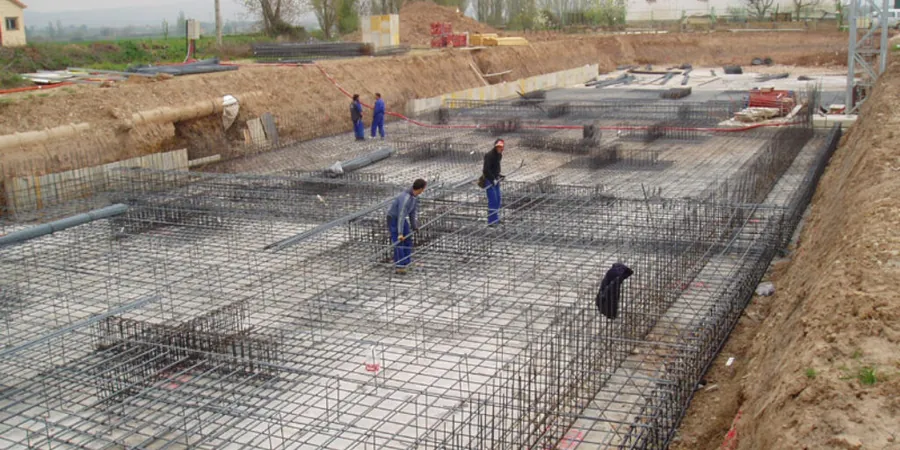
A 5-story mixed-use project on Milwaukee Avenue got flagged last fall. The excavation exposed old ash fill and organics nobody planned for, and the original spread footing design was suddenly useless. That's the Chicago reality: the upper 10 to 15 feet of soil in much of the city is urban fill, dumped after the Great Fire of 1871 and built over for 150 years. Shallow foundation design here doesn't start with textbook formulas. It starts with figuring out what's actually under the slab. We combine test pits for visual logging with grain-size analysis to classify the fill matrix, then run settlement calculations that account for compressible lenses. A footing on undisturbed glacial till performs completely differently than one sitting on rubble and brick fragments, and our bearing capacity recommendations reflect that difference immediately.
Chicago's urban fill is not a single material; it's a century and a half of debris, and each layer changes the bearing capacity calculation.
Local context
The USGS Quaternary geology maps for the Chicago Loop show a patchwork of Lake Michigan lacustrine deposits, beach sand, and artificial fill. The fill thickness is highly variable: we've logged 2 feet of fill on a Lincoln Park site and 18 feet on a Near South Side parcel two miles away. That variability is the primary risk for shallow foundation design. A footing bearing partially on fill and partially on natural clay tilts. The clay itself can be overconsolidated near the surface, then normally consolidated below, producing long-term settlement that continues for decades. Add the seasonal moisture cycles from Chicago's freeze-thaw pattern, and you get cyclic heave in fat clays with high plasticity. We mitigate this by undercutting and replacing poor material with compacted structural fill, or by deepening footings to a uniform bearing stratum. Where the water table is shallow, less than 6 feet below grade in many areas near the Chicago River, we also check for buoyancy effects and softening of the subgrade during excavation.
Top questions
How deep do footings need to be in Chicago to avoid frost heave?
The Chicago Building Code, aligned with IBC Section 1809.5, requires a minimum footing depth of 42 inches below finished grade. That places the bearing surface below the frost penetration zone. For unheated structures or sites with exposed footings, we specify deeper embedment or insulation per ASCE 32.
What is the typical cost range for a shallow foundation design for a single-family home in Chicago?
For a standard residential lot in Chicago, the geotechnical investigation and shallow foundation design package typically runs between US$2,150 and US$3,320. The final figure depends on how many borings or test pits are needed and whether lab testing goes beyond basic classification to include consolidation or direct shear.
Can you design shallow foundations on Chicago's urban fill without deep soil removal?
It depends on the fill composition and density. If the fill is granular and can be compacted to 95% of modified Proctor, we can often design a spread footing on an engineered fill pad after undercutting the top 2 to 3 feet. If the fill contains organic material, rubble, or uncompacted ash, we recommend removal down to natural soil or a mat foundation to bridge the weaker zones.
What happens if differential settlement exceeds the design limit after construction?
If differential settlement causes cracking or door/window binding, we perform a forensic investigation using test pits and precise level surveys. The fix may involve underpinning the settled footing with push piers or injecting low-mobility grout to densify the bearing soil. The solution depends on whether the movement is ongoing or has stabilized.